By: Retave’s Technology Desk Editor
You can rewrite every syllabus in the country, but if the lecturer standing at the front of the hall doesn’t know how to use the tools themselves, the new syllabus is just paper.
That gap hasn’t gone unnoticed. Over the past year, two of the world’s biggest tech companies have quietly become part of how Malaysia trains its own university staff, working directly with government agencies to do it.
What Malaysia has actually rolled out so far
In March 2026, Google confirmed that all 20 Malaysian public universities had enabled Gemini for Education within their existing Google Workspace accounts, reaching nearly 600,000 students and 75,000 faculty members across diverse disciplines, including engineering, social sciences, and business. The Ministry of Higher Education extended this by granting 40,000 lecturers access to the premium Google AI Pro tier and providing 128,000 students with Notebook Enterprise for research, ensuring broad applicability across academic fields. At Universiti Malaysia Sarawak, more than 500 lecturers have completed Google Workspace training, with 120 earning formal certification as Gemini Certified Educators, demonstrating commitment to discipline-specific AI integration.
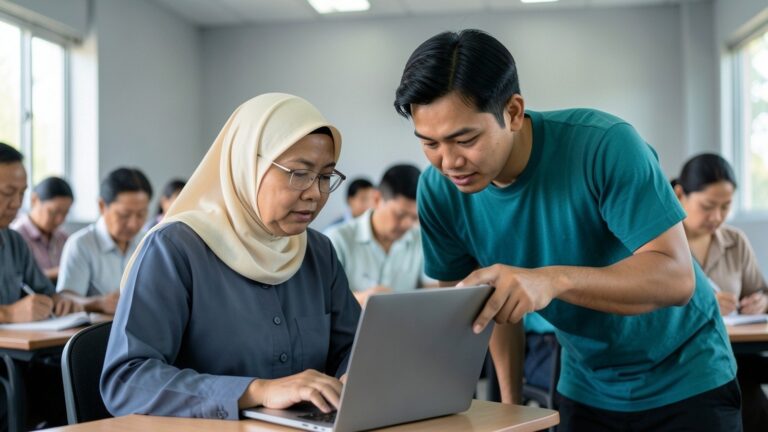
A month later, Malaysia’s Ministry of Digital launched a second front. On 24 April, Minister of Digital YB Gobind Singh Deo officiated the launch of Microsoft Elevate, run with the National AI Office and delivery partners Biji-biji Initiative and Mereka. Unlike the Google rollout, which sits inside university IT systems, Elevate is built specifically around training people: teachers across universities, TVET institutions, and schools, in practical, role-based AI skills for teaching and curriculum design. Its pilot phase, running since January, had already reached 80,000 learners by launch day, with ongoing support and evaluation mechanisms in place to ensure skill retention and application, building on two earlier Microsoft programmes that trained 800,000 and 1.53 million Malaysians respectively in digital and AI skills.
What the national AI plan asks for next
Both rollouts demonstrate Malaysia’s commitment to the AI Nation 2030 plan, fostering a sense of collective effort among educators, government, and private partners.
- Educator AI Mobility and Fellowships
Sending lecturers on sabbaticals and attachments inside AI research groups and companies, giving them hands-on placement time that a seminar can’t match
- Educator Upskilling Programmes
Structured bootcamps, recognised certification tracks, and peer learning networks built for people already stretched between teaching and research
- National Virtual AI Lab
A shared facility offering computing power, ready-to-use datasets, and safe testing environments, so individual faculties don’t each need to build their own infrastructure
The Google and Microsoft rollouts already cover pieces of that list. Certification tracks like Gemini Certified Educators and role-based Elevate training are the upskilling piece in action. The compute access bundled into Google AI Pro and Workspace accounts does some of what a national lab is meant to do. However, the fellowship and mobility initiatives-such as embedding lecturers directly inside research teams-remain in planning stages, with future programs expected to focus on hands-on research placements and collaborative projects to deepen practical AI expertise among educators.
Curriculum reform and personalised learning only succeed if educators can troubleshoot AI tools effectively, making practical skills essential for their confidence and effectiveness.
Further Reading
- Malaysia’s Plan to Put AI in Every University Curriculum
- AI in the Classroom, AI in the Career Office: Malaysia’s Plan for Personalised Tertiary Learning
- Malaysia’s New Apprenticeship Economy: From General STI Talent to AI-Specific Pathways
Sources
National AI Action Plan 2026-2030 (AI Nation 2030), Ministry of Digital / AI Malaysia Berhad (National AI Office), Malaysia, published July 2026. Google, “Enabling Gemini for Education across all Malaysian public universities,” blog. Google, 8 March 2026. Microsoft, “Malaysia deepens national AI partnership with Microsoft,” news.microsoft.com, 24 April 2026.