

By: Retave’s Education Desk Editor
Malaysia’s graduate employment rate sits in the low nineties, and the number repays a closer look.
The latest figures
The rate is built from tracer data on more than 236,000 graduates. The Ministry of Higher Education’s (MOHE) Statistics of Higher Education 2025, published this year, puts the Graduate Employment rate (GE) for 2025 at 92.3%. Of the 236,047 Malaysian graduates in its tracer data, 217,768 were working. The rate for 2024 was 92.5%.
On its own performance page, MOHE sets that 2024 figure against 75% in 2014. It notes that the original goal, a rate above 80% by 2025, has been passed.
What “employed” means here
The figures come from the ministry’s Graduate Tracer Study, or SKPG, short for Sistem Kajian Pengesanan Graduan. Starting in 2024, the ministry has reported two separate rates, as Universiti Teknologi Malaysia (UTM) set out when it published its own results:
- GE (Kadar Bekerja Graduan) counts only graduates who are in work.
- The Graduate Marketability rate (GM, Kadar Kebolehpasaran Graduan) adds graduates who’ve gone on to study further, are upskilling, or are still waiting to be placed in a job.
The 92.3% is the narrower of the two: the share of graduates with a job.
How the rate varies
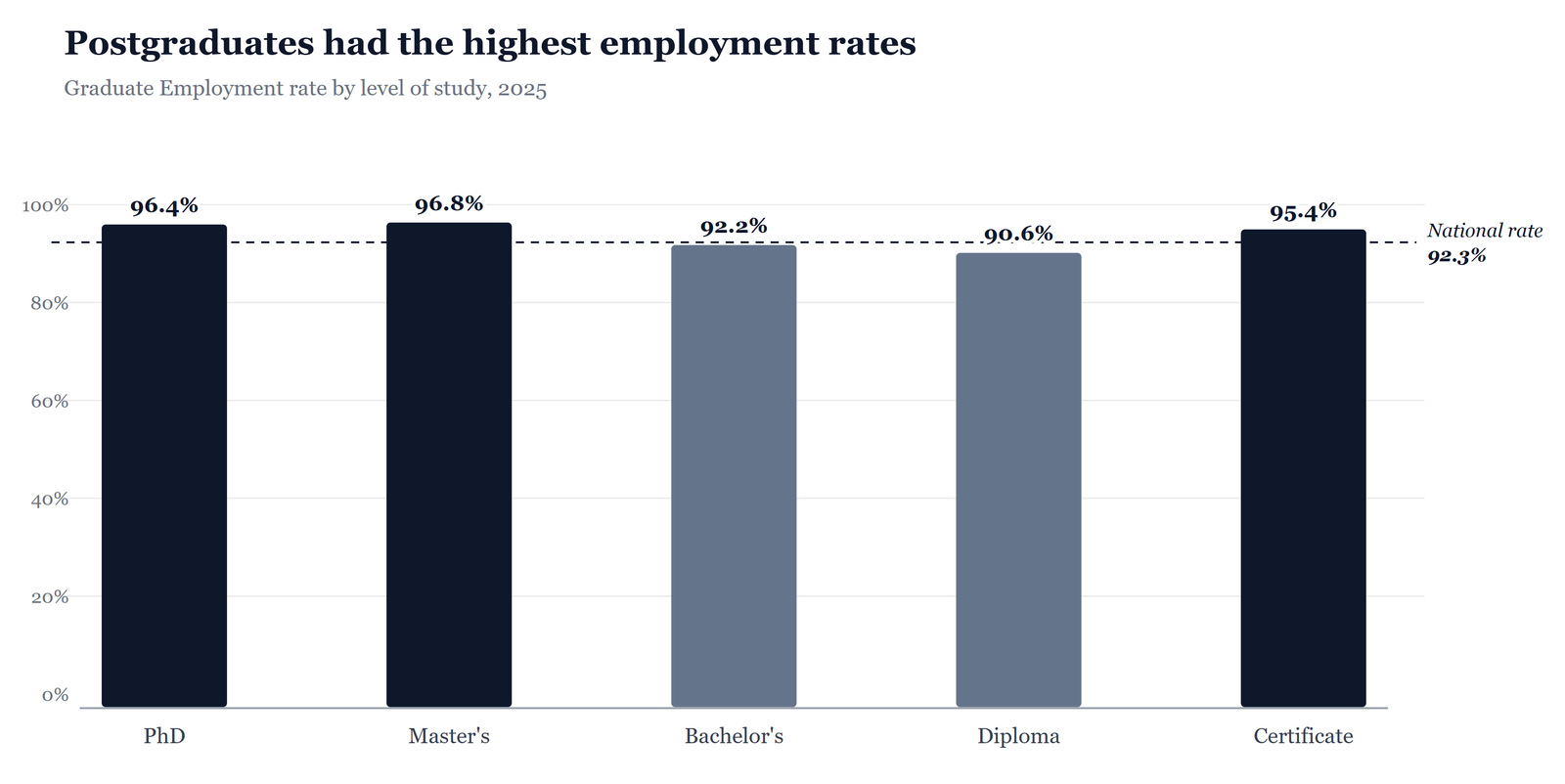
The 2025 tables break the rate down several ways. By level of study:
- PhD: 96.4%
- Master’s: 96.8%
- Bachelor’s: 92.2%
- Diploma: 90.6%
- Certificate: 95.4%
Free to use with credit to RETAVE.
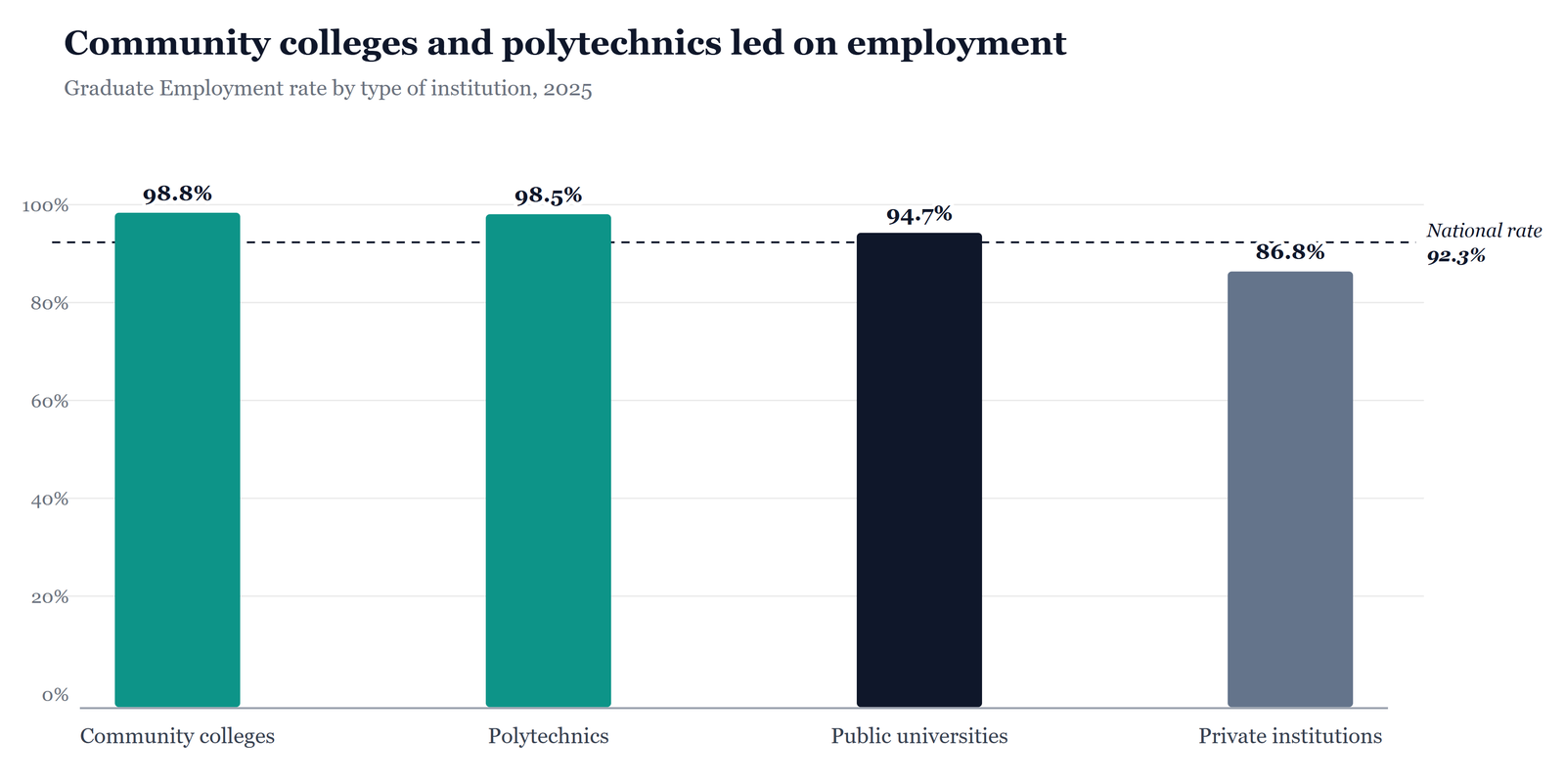
By type of institution, public universities came in at 94.7% and private higher education institutions at 86.8%. Polytechnics reached 98.5% and community colleges 98.8%.
Free to use with credit to RETAVE.
Permanent posts, contracts and gig work
The tracer data also records the terms on which graduates are employed.
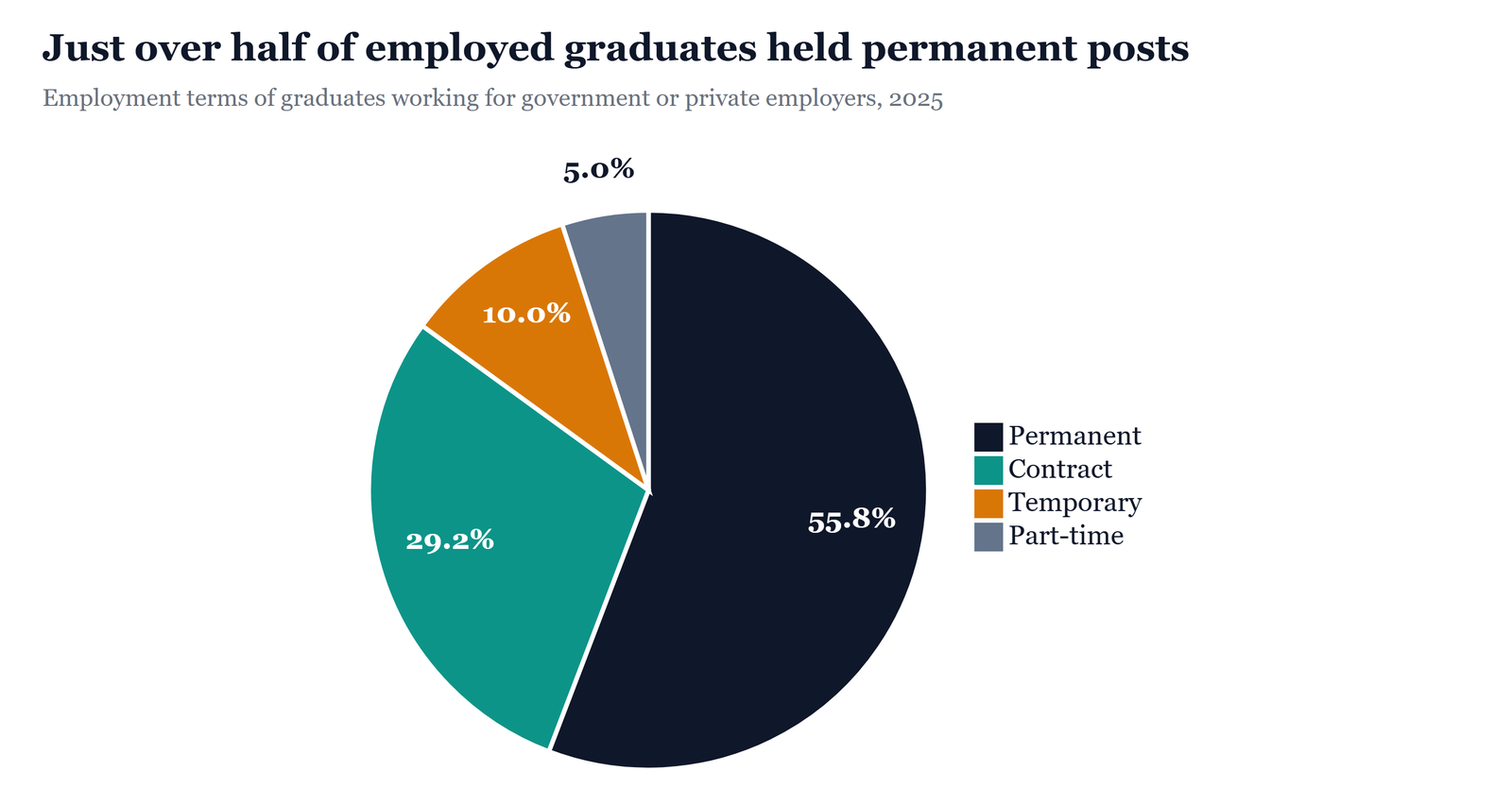
Of the 185,428 graduates working for government or private employers in 2025, 55.8% held permanent posts. Another 29.2% were on contract, 10.0% in temporary posts and 5.0% part-time. In 2024, the permanent share was 57.3%.
Free to use with credit to RETAVE.
The tables also show where graduates work. In 2025, 54.4% of employed graduates were employed by local private companies, and 15.2% by multinationals. The gig economy, which MOHE’s tables illustrate with examples such as ride-hailing, delivery, and dropshipping, accounted for 5.8%, down from 8.6% in 2024.
Where pay comes in
The tracer tables in MOHE’s statistics yearbook don’t include salaries. For pay, the reference point is the Department of Statistics Malaysia (DOSM). Its Graduates Statistics 2024 put the median monthly salary and wage for graduates at RM4,521, up from RM4,409 in 2023.
DOSM also shows how much the level of the job matters. Graduates in skilled jobs earned RM5,723 a month in 2024, compared with RM2,550 in semi-skilled jobs and RM1,990 in low-skilled jobs.
The two sources survey different groups, so they don’t add up to one figure. Read together, MOHE’s rate shows whether graduates are working, and DOSM’s pay data shows what the level of that work is worth.
What MOHE plans next
On 20 August, MOHE launched its Graduate Employability Strategic Plan (Pelan Strategik Kebolehpasaran Graduan, PSKG) 2026–2030 at its Graduate Employability Conference 2026 in Kuala Lumpur. The plan’s vision is “Adaptive, Agile and Resilient Graduates as Catalysts for a High-Income Nation.” The conference discussed job mismatches and starting salaries, as well as collaboration between industry and universities.
Higher Education Minister Datuk Seri Dr Zambry Abd Kadir said workforce needs should be assessed jointly across ministries and agencies. “We do not assess this based on the ministry alone,” he said. The plan involves the Economy Ministry, the Ministry of Investment, Trade and Industry (MITI), and the Human Resources Ministry (KESUMA). Datuk Seri Dr Zambry also pointed to the Industry in Campus programme, which the ministry is implementing at Malaysia’s technical universities, among others.
The question of what the rate measures came up again in September. At a polytechnic and community college convocation in Kota Kinabalu on 21 September, Datuk Seri Dr Zambry urged the institutions to “ensure graduates secure jobs that match their skills,” building on employability rates above 98% the year before.
Two days later, the Malaysian Employers Federation (MEF) described the 2025 rates of 98.5% for polytechnic graduates and 98.8% for community college graduates as encouraging, and proposed broader measures, such as whether graduates work in fields related to their training, starting pay and wage growth, career progression and employer satisfaction. “We should distinguish between being employed and being appropriately employed,” said MEF senior adviser Datuk Dr Syed Hussain Syed Husman.
Reading your own number
For a programme head, the national rate is a benchmark, and the breakdowns are the more useful part. Put your programme’s rate next to the average for its level and type of institution. Then track what the yearbook tables already track nationally: the share of graduates on permanent terms, and the share in gig work in their first job after graduating.
Quick quiz
How much do you remember?
1. What was the 2025 graduate employment rate?
217,768 of 236,047 graduates were employed.
2. Which group of graduates had the highest employment rate?
Community colleges reached 98.8%, just ahead of polytechnics at 98.5%.
3. What was the median monthly salary for graduates in 2024, according to DOSM?
The Department of Statistics Malaysia (DOSM) put it at RM4,521, up from RM4,409 in 2023.
Further Reading
- Education and ICT: the two fields to watch in Malaysia’s 2025 graduate employment numbers
- One in three, and two in three under 25: what DOSM’s latest numbers say about skill-related underemployment
- Malaysia’s Higher Education, By the Numbers: It’s quest to become a Global Education Hub
Sources
- Bernama. (2026, August 21). UTM maintains 100 pct graduate employment rate since 2023. https://bernama.com/en/general/news.php?id=2597510
- Bernama. (2026, September 23). Broader assessment of TVET employability needed – MEF. https://bernama.com/en/news.php?id=2610784
- Department of Statistics Malaysia. (2025, October 31). Graduates statistics 2024. https://www.dosm.gov.my/uploads/release-content/file_20260401145140.pdf
- Malay Mail. (2026, August 20). Zambry: Higher Education Ministry unveils 2026-2030 plan to strengthen graduate employability. https://www.malaymail.com/news/malaysia/2026/08/20/zambry-higher-education-ministry-unveils-2026-2030-plan-to-strengthen-graduate-employability/232032
- Ministry of Higher Education Malaysia. (n.d.). Statistik pendidikan tinggi 2024: Bab 7 [Statistics of higher education 2024: Chapter 7]. https://mohe.gov.my/en/download/statistics/2024-4/1708-bab-7-tracer-study-2024-pdf/file
- Ministry of Higher Education Malaysia. (n.d.). Prestasi semasa [Current performance]. https://www.mohe.gov.my/en/rptm-prestasi-semasa
- Ministry of Higher Education Malaysia. (2026). Statistik pendidikan tinggi 2025: Bab 7 [Statistics of higher education 2025: Chapter 7]. https://mohe.gov.my/en/download/statistics/2025-1-1/1845-bab-7-skpg-2025-pdf/file
- New Straits Times. (2026, September 21). Ensure polytechnic, community college grads secure jobs matching their skills – Zambry. https://www.nst.com.my/news/nation/2026/09/1537684/ensure-polytechnic-community-college-grads-secure-jobs-matching-their
- Universiti Teknologi Malaysia. (2025, April 13). UTM catat 100% bagi Kadar Bekerja Graduan (GE) dan Kadar Kebolehpasaran Graduan (GM). https://news.utm.my/2025/04/utm-catat-100-bagi-kadar-bekerja-graduan-ge-dan-kadar-kebolehpasaran-graduan-gm-warganegara/