

By: Retave’s Education Desk Editor
Two in three of Malaysia’s working graduates aged 24 and below hold jobs below their qualification level, according to the Department of Statistics Malaysia (DOSM). Across all age groups, the national rate is edging down.
DOSM’s name for this is skill-related underemployment. It counts a worker as underemployed in this sense when they have tertiary education but work in a semi-skilled or low-skilled occupation. DOSM publishes the measure in more than one version.
The annual figure for 2025
DOSM’s labour force statistics for 2025, released on 26 June 2026, put skill-related underemployment at 35.6%, down from 36.1% in 2024.
In people, that looks like this:
- 2.05 million tertiary-educated workers were in semi-skilled or low-skilled jobs in 2025
- about 8,700 fewer than the 2.06 million in 2024
- the rate ranged from 22.8% in Kuala Lumpur, the lowest in the country, to 50.5% in Kelantan, the highest
The wider job market had a good year. Unemployment fell to 3.0%, which DOSM described as the lowest in a decade, and the number of employed people grew 1.3% to 16.58 million.
A lower reading in the second quarter
The most recent reading comes from DOSM’s Labour Market Review for the second quarter of 2026, published on 27 August. Skill-related underemployment stood at 35.2%, 0.5 percentage points lower than a year earlier. DOSM noted that it covered more than one-third of employed people with tertiary education.
The direction over the past year is gently downward.
A graduates-only count
DOSM’s Graduates Statistics 2024, released on 31 October 2025, gives a third, lower figure. It counted 1.60 million graduates working below their qualification level, a graduate skill-related underemployment rate of 32.2%.
The gap between 32.2% and 35.6% comes from the two reports measuring different groups in different years. The graduates report uses its own definition of a graduate: someone whose highest qualification took at least two years of study at a university, college, polytechnic or a recognised equivalent. The figures can be read side by side, though not subtracted one from the other.
The graduates report adds two details. First, the rate edged down from 32.4% in 2023 even though the number of underemployed graduates rose 3.9%, because employed graduates grew faster, up 4.6% to 4.98 million. Second, the gap by age is wide:
- graduates aged 24 and below: 66.0%
- graduates aged 45 and above: 18.6%
Each figure is a snapshot of a single year, and the highest rate comes right at the start of working life.
What the job level means for pay
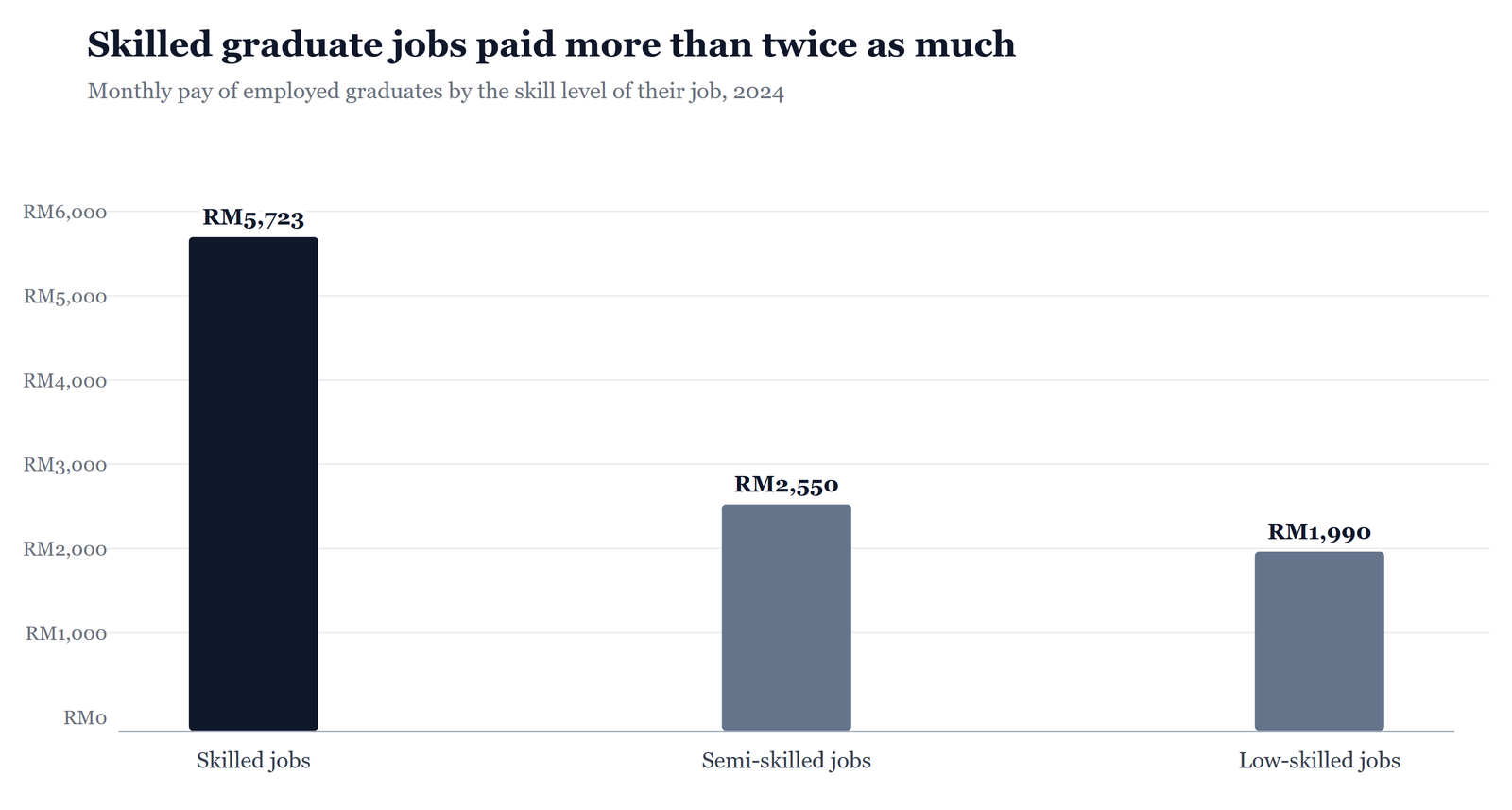
The same report shows what those percentages mean on a payslip. In 2024, according to DOSM’s pay figures by occupational skill level, graduates in skilled jobs earned RM5,723 a month. Those in semi-skilled jobs earned RM2,550, and those in low-skilled jobs RM1,990.
The gap between a skilled and a semi-skilled graduate job is more than RM3,000 a month, and most graduates are already on the higher side of that line: 67.8% of employed graduates, or 3.38 million people, worked in skilled jobs.
The jobs the economy is creating
Of the 31,500 jobs DOSM recorded as created in the second quarter of 2026, 66.1% were semi-skilled and 25.2% were skilled.
The underemployment rate moves with that mix of jobs as well as with the qualifications of the people filling them.
Skill level, measured on its own
Skill-related underemployment is about the skill level of the job rather than whether it matches the subject someone studied. A history graduate working as a marketing manager isn’t counted as underemployed, because managers are a skilled occupation. An engineering graduate working as a sales assistant is.
Where the next figures come from
DOSM’s next annual graduates report, covering 2025, will update the graduates-only rate along with the age and pay breakdowns. Later articles in this series look at the Ministry of Higher Education’s own tracer data, field by field.
For a programme head or a careers office, alumni data can go a step further than the national figures. It can show how many graduates started in skilled roles and how many reached one within three years, a picture of each programme’s own route into skilled work.
Further Reading
- Inside Malaysia’s graduate tracer study: what the 92.3% employment rate counts, and where pay comes in
- Education and ICT: the two fields to watch in Malaysia’s 2025 graduate employment numbers
- “Employed, but in the right job?” What the 98.5% and 98.8% TVET employability rates tell us
Sources
- Department of Statistics Malaysia. (2025, October 31). Graduates statistics 2024. https://www.dosm.gov.my/uploads/release-content/file_20260401145140.pdf
- Department of Statistics Malaysia. (2026, June 26). Labour force statistics, Malaysia, 2025 [Media statement]. https://www.dosm.gov.my/uploads/release-content/file_20260626114308.pdf
- Department of Statistics Malaysia. (2026, August 13). Employment statistics, second quarter 2026. https://www.dosm.gov.my/portal-main/release-content/employment-statistics-Q22026
- Department of Statistics Malaysia. (2026, August 27). Labour market review, second quarter 2026. https://www.dosm.gov.my/portal-main/release-content/labour-market-review-lmr-q22026