
By: Retave’s Research Desk Editor
Malaysian applicants lodged 1,224 applications for patents and utility innovations in 2025, according to the Intellectual Property Corporation of Malaysia (MyIPO), the national patent office. The count is 23 per cent higher than in 2024, marks a third straight yearly rise and is the highest since 2018.
Utility innovations are MyIPO’s lighter form of protection for smaller, incremental inventions, and the office reports them together with patents. Both give an inventor exclusive rights over a new product or process.
Complexity, in plain terms
Economists use “economic complexity” to describe how many different products an economy can make, and how few other economies can make them. A country that can produce advanced medical implants, specialised chemicals and precision tools has built up more know-how than one that assembles parts designed elsewhere.
Malaysia’s New Industrial Master Plan 2030 (NIMP 2030), the manufacturing plan of the Ministry of Investment, Trade and Industry (MITI), names this as its first mission: “Advance economic complexity.” The mission centres on “encouraging the industry to innovate and produce more sophisticated products to increase economic complexity”. It credits the research, development, commercialisation and innovation (RDCI) cycle with “a pivotal role in enhancing economic complexity.”
Patents sit inside that cycle. An application shows that research has reached a concrete claim on an invention. NIMP 2030 backs this with an intellectual property (IP) action plan: to “digitalise IP application and launch enhanced National IP Policy”.
Home-grown filings take a bigger share
MyIPO received 7,922 applications in 2025. Foreign applicants filed 6,698 of them. Malaysian applicants accounted for 15.5 per cent of all filings in 2025, up from 13.4 per cent in 2024.
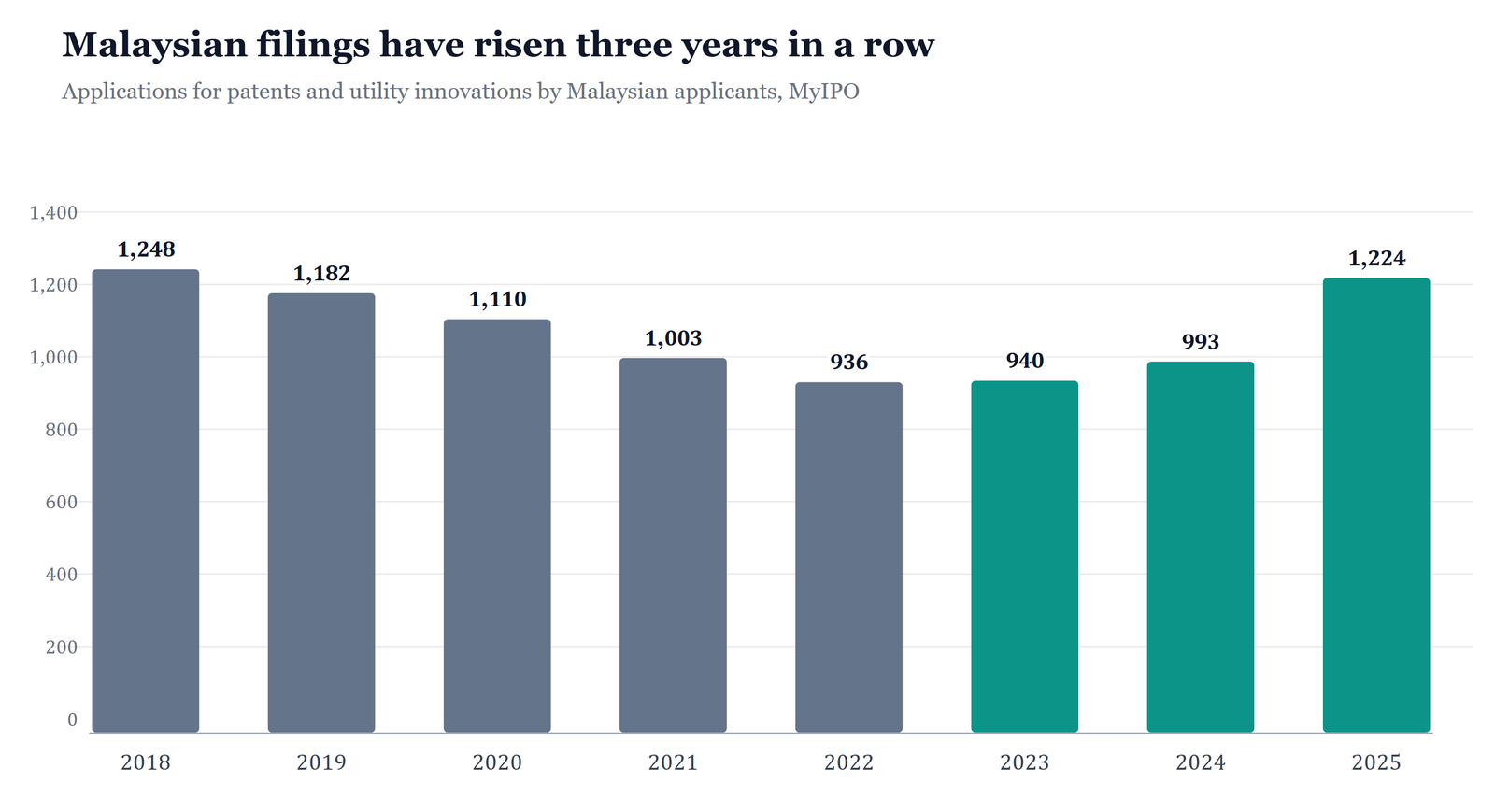
The longer series shows the climb. From 936 in 2022, Malaysian filings turned upward in 2023 and gained momentum in 2024 and 2025. Since MyIPO’s records began in 1986, Malaysian applicants have filed 26,350 applications for patents and utility innovations.
The international view
The Global Innovation Index (GII) 2026 of the World Intellectual Property Organization (WIPO) places Malaysia 34th of 139 economies and second among 35 upper-middle-income economies. Its short-term tracker records Malaysia’s international patent filings rising 10.2 per cent from 2024 to 2025, alongside an 11.4 per cent rise in scientific publications.
The index also ranks Malaysia first among the 139 economies it covers for high-tech exports as a share of total trade.
Where the next filings can come from
Universities and research institutes can add to the count. The national science policy’s plans for pooling and valuing their inventions are covered in our companion piece, “From lab bench to local brand: Malaysia’s plan for turning research into products”.
The 2026 figure will be the first chance to extend the run of rises to four years.
Further Reading
- Budget 2027 puts RM6 billion into research, and opens a road from the lab to the market
- Malaysia’s Innovation Policy and the Role of Universities in National R&D
- The lab work inside Malaysia’s net-zero mission, and the funds that can pay for it
Sources
- Intellectual Property Corporation of Malaysia. (n.d.). Statistic application & registration. https://www.myipo.gov.my/statistic-application-registration/
- Ministry of Investment, Trade and Industry. (n.d.). Missions. New Industrial Master Plan 2030. https://www.nimp2030.gov.my/index.php/pages/view/317
- World Intellectual Property Organization. (2026). Malaysia ranking in the Global Innovation Index 2026 [Economy profile]. https://www.wipo.int/edocs/gii-ranking/2026/my.pdf