
By: Retave’s Research Desk Editor
The final step in one of Malaysia’s flagship climate projects is a job for chemists. Mission-based project 3.3 of the New Industrial Master Plan 2030 (NIMP 2030) will deploy carbon capture, utilisation and storage (CCUS) at scale for the metal, cement, chemical and petroleum industries. Capture, transport by ship, pipeline and land, and storage in depleted oil fields come first. Utilisation comes last: the “development of products from captured CO2 and aligned to circular economy principles.”
Turning captured carbon into something worth selling is laboratory work, and Malaysia’s universities already carry out more than a third of the country’s research and development (R&D).
A mission written for factories
NIMP 2030 is the manufacturing plan of the Ministry of Investment, Trade and Industry (MITI). Its third mission, Push for Net Zero, “aims to decarbonise the manufacturing sector to achieve Net Zero emissions as early as 2050 while capitalising on new green growth areas.”
The mission sets out four strategies, carried by 10 action plans:
- Sustainable practices: decarbonisation pathways for each sector, a focus on “hard-to-abate” sectors, carbon policy, accounting and tax, and MITI’s iESG framework, its environmental, social and governance guide for industry.
- Renewable and clean energy: schemes that help factories adopt energy efficiency and renewable energy, and easier access to renewable power for industry.
- New green growth areas: electric vehicles (EVs), CCUS as a sector in its own right, and a circular economy framework.
- Green infrastructure: turning industrial estates into eco-industrial parks.
Three mission-based projects carry the strategies into practice. One creates decarbonisation role models that other companies in the same sector can follow. Another launches a locally manufactured EV. The third is the CCUS deployment.
Where Malaysia’s research gets done
For researchers, the baseline sits in the National Survey of Research and Development, which the Ministry of Science, Technology and Innovation (MOSTI) runs every two years with the Department of Statistics Malaysia (DOSM). The Malaysian Science and Technology Information Centre (MASTIC) publishes the results.
The latest round, for 2022, recorded gross expenditure on R&D (GERD) of RM18,156.1 million, which MASTIC calls a historic milestone. Business enterprises carried out 51.37 per cent of that spending, higher learning institutions 37.17 per cent and government research institutes 11.40 per cent.
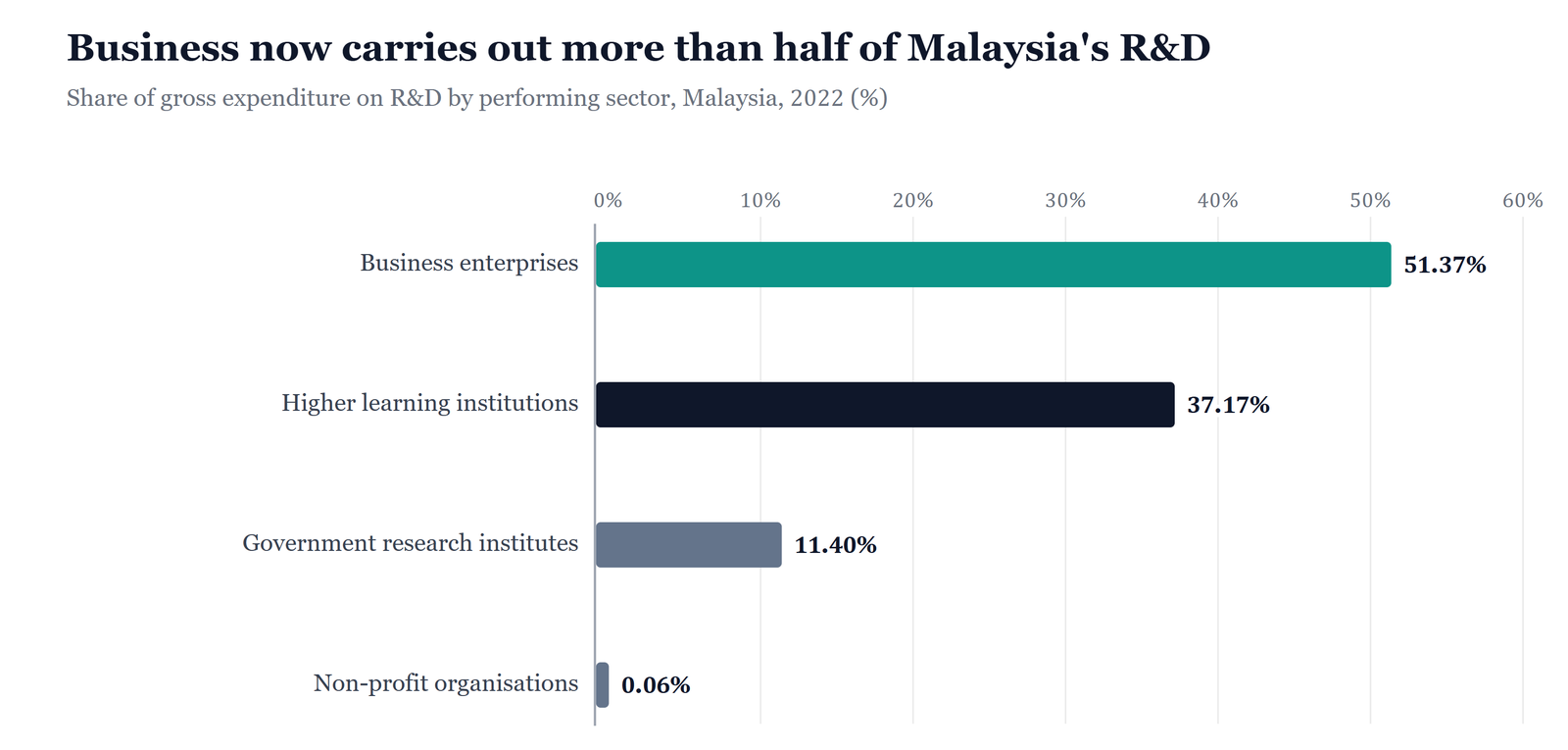
The business share climbed from 34 per cent in 2020, a shift MASTIC describes as “a healthy recalibration toward commercialization and market-led research.” R&D spending reached 1.01 per cent of gross domestic product (GDP) in 2022, up from 0.95 per cent in 2020. The national goal is 3.5 per cent by 2030, with 60 per cent of the money from the private sector and 40 per cent from government.
Doors already open to campus labs
Green research money reaches universities through science and investment channels that run alongside the mission:
- MOSTI’s Strategic Research Fund (SRF). Part of the ministry’s Dana Pemacu programme and run by the Malaysian Research Accelerator for Technology and Innovation (MRANTI), the SRF backs research in national priority areas, and higher learning institutions can apply alongside startups and spin-offs. Projects need a proof of concept and a technology readiness level (TRL) of 2 to 9 on a nine-step scale. Its Cohort 7 call, opened in January 2025, listed “Clean Energy, Green Energy, Renewable Energy, Hydrogen” among MOSTI’s priority areas.
- Impact-based research funding. In July 2025, MOSTI put the expansion of impact-based research funding first among its five initiatives for national R&D, widening access for companies and research institutions “especially in green, digital and sustainable technologies.”
- Topics set with industry. NIMP 2030’s first mission includes an action plan to “assign specific topics and KPIs to universities for industrial-linked R&D”.
- Budget 2027. The budget speech of 9 October 2026 commits RM1 billion through KWAP Dana Iklim+, a climate fund of KWAP, the Retirement Fund (Incorporated), to “green projects such as renewable energy and decarbonisation.” It also extends Investment Tax Allowances of up to 100 per cent for green and sustainable technology projects to 31 December 2030.
The cross-ministry research lines are covered in our Budget 2027 explainer, “Budget 2027 puts RM6 billion into research, and opens a road from the lab to the market”.
The next projects on MITI’s list
MITI says it will keep working with industry to identify more mission-based projects “through the course of the industrial policy.” Each new project that carries a research step, as CCUS does with carbon utilisation, gives university laboratories another question to take on, with 2050 as the mission’s horizon.
Further Reading
- Aerospace, chips, and pharma: where TVET graduates fit in three NIMP 2030 sectors
- Budget 2027 puts RM6 billion into research, and opens a road from the lab to the market
- Setting Malaysia’s Research Priorities — and Paying for Them
Sources
- Malaysian Research Accelerator for Technology and Innovation. (n.d.). MRANTI Strategic Research Fund (SRF). https://mranti.my/innovators/connect/srf
- Malaysian Science and Technology Information Centre. (n.d.-a). Driving innovation: Malaysia’s national R&D expenditure target by 2030. Ministry of Science, Technology and Innovation. https://mastic.mosti.gov.my/driving-innovation-malaysias-national-rd-expenditure-target-by-2030/
- Malaysian Science and Technology Information Centre. (n.d.-b). Research and development (R&D) indicators. Ministry of Science, Technology and Innovation. https://mastic.mosti.gov.my/statistic/research-and-development-rd-indicators/
- Ministry of Finance Malaysia. (2026). Budget 2027 speech [English translation of the speech by Prime Minister and Finance Minister Anwar Ibrahim, tabled in the Dewan Rakyat on 9 October 2026]. https://belanjawan.mof.gov.my/pdf/belanjawan2027/ucapan/bs27.pdf
- Ministry of Investment, Trade and Industry. (n.d.-a). Mission-based projects. New Industrial Master Plan 2030. https://www.nimp2030.gov.my/index.php/pages/view/110
- Ministry of Investment, Trade and Industry. (n.d.-b). Missions. New Industrial Master Plan 2030. https://www.nimp2030.gov.my/index.php/pages/view/317
- Ministry of Science, Technology and Innovation. (2025, July 17). Increased investment and participation in research & development (R&D) strengthens Malaysia’s aspiration to become a high-income, innovation-driven nation [Press release]. https://www.mosti.gov.my/wp-content/uploads/2025/07/17072025.1080073394.pdf