

By: Retave’s TVET Desk Editor
Ninety-eight and a half per cent of Malaysia’s 2025 polytechnic graduates were counted as employed. Community colleges came in even higher, at 98.8%. Both are core parts of Malaysia’s technical and vocational education and training (TVET) system, and on most report cards, numbers like these end the conversation.
The Malaysian Employers Federation (MEF) would like it to keep going. On 23 September, MEF senior adviser for government, media and international engagement Datuk Dr Syed Hussain Syed Husman called both rates encouraging, then raised the question sitting underneath them: “A graduate may be employed, but the critical question is whether the job utilises the skills acquired.”
What the rates measure
The figures line up with what the Department of Polytechnic and Community College Education (JPPKK), which runs both networks, has said this year. In July, JPPKK senior director for academic affairs Dr Mohd Daud Isa said that more than 98% of those finishing at polytechnics and community colleges had found jobs, and that the rate has stayed above 95% every year.
He named hospitality, culinary arts, engineering and manufacturing as the main sectors taking them on, with many graduates receiving offers during their work-based learning placements.
It also helps to know what’s being counted. The Ministry of Higher Education’s (MOHE) Graduate Tracer Study, known by its Malay initials SKPG (Sistem Kajian Pengesanan Graduan), has reported two rates since 2024. The Graduate Employment rate counts only graduates who are in work; a wider Graduate Marketability rate adds those studying further, upgrading their skills or waiting for a job placement.
The 98.5% and 98.8% figures match MOHE’s 2025 Graduate Employment rates for polytechnics and community colleges, which count graduates in employment. Public skills-training institutions are tracked through a dedicated version, SKPG-TVET.
The rate is a solid measure of whether graduates land somewhere.
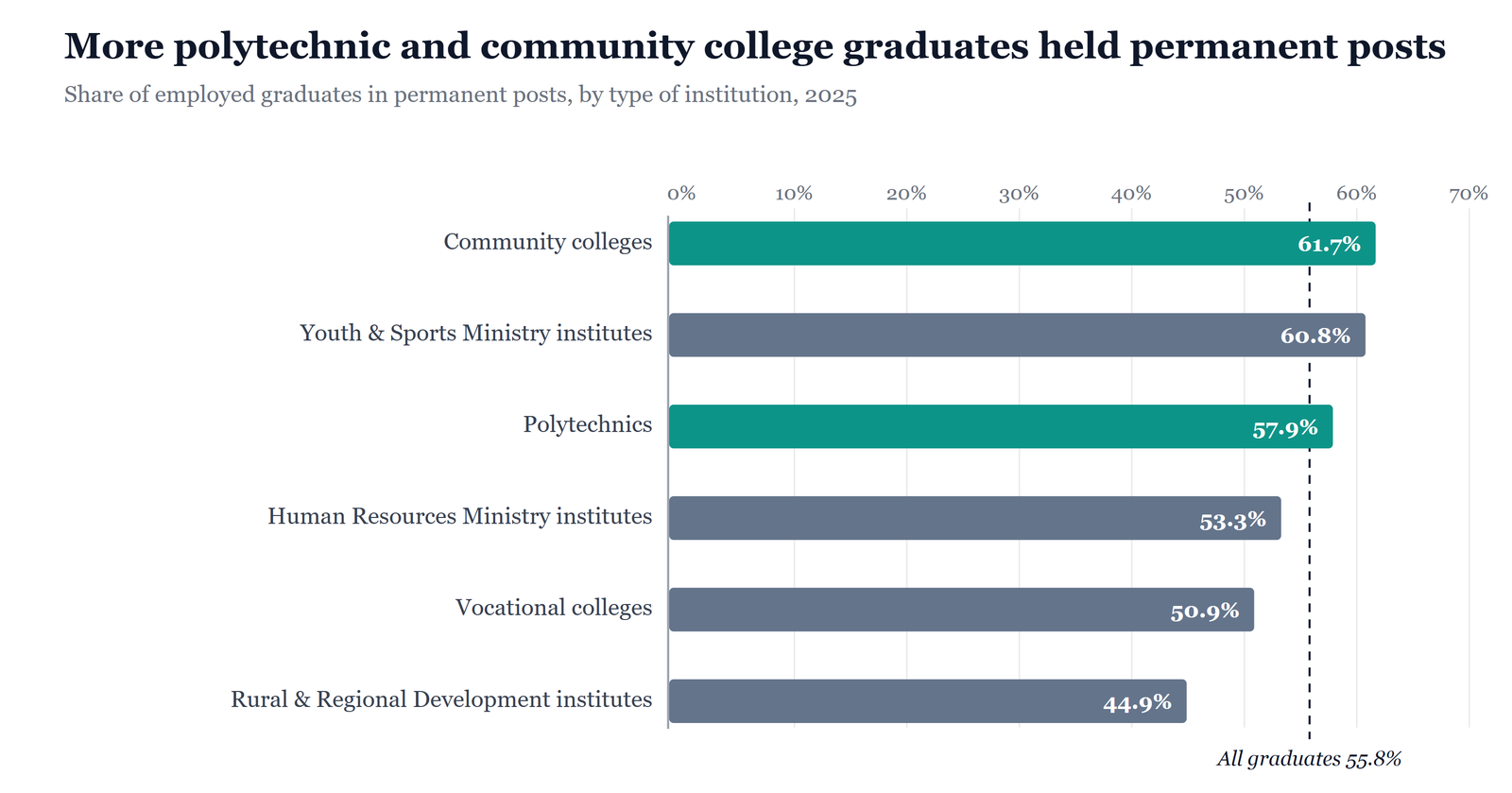
The tracer tables do record one thing about the jobs themselves: the terms on which graduates are hired. In 2025, 61.7% of employed community college graduates working for government or private employers held permanent posts, and 57.9% of polytechnic graduates did so, compared with 55.8% of all graduates. Gig work was more common among community college graduates, at 10.5% of those employed, than the 5.8% across all graduates.
Free to use with credit to RETAVE.
What employers want measured next
MEF accepts the rates. Its point is that they answer one question, and employers want several more answered. Datuk Dr Syed Hussain listed what MEF would like future reporting to cover:
- whether graduates work in the field they trained for
- what they earn at the start, and how their pay grows
- the career development open to them
- how satisfied their employers are
- how ready for work they are on day one
- whether they hold certifications industry recognises
- how much further learning and retraining they take up
- whether they move on into higher-value, higher-skilled roles
He also looked beyond the classroom. “If we want our TVET graduates to have good jobs, we must create more good jobs,” he said. “Education policy and investment policy must move together.”
Skill levels in the jobs being created
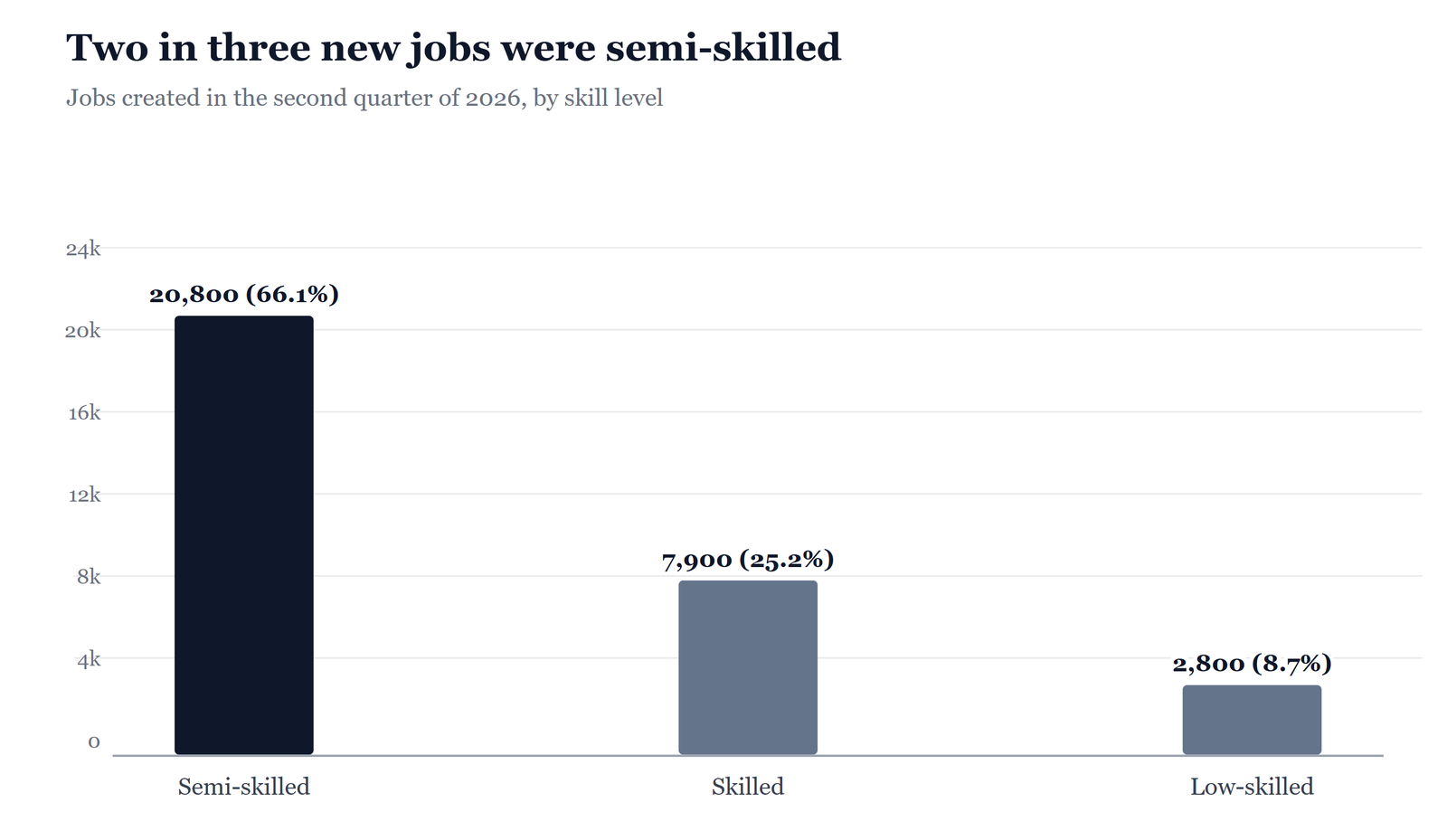
The Department of Statistics Malaysia (DOSM) provides insight into the job market from the employer’s perspective. In the second quarter of 2026, semi-skilled roles made up 62.0% of all jobs in the economy and 66.1% of the 31,500 jobs created that quarter. Skilled roles accounted for 25.2% of new jobs, and low-skilled roles for 8.7%.
Most new openings in the economy sit at the semi-skilled level, which is why MEF wants the skill level of graduates’ jobs tracked alongside the placement rate.
DOSM’s graduate figures show why that level matters for pay. Malaysia had 5.98 million graduates in 2024, which DOSM defines as people whose highest qualification, of at least two years’ study, is from a university, college, polytechnic, or an equivalent body. Of those in work, 31.0% held semi-skilled jobs, at a median monthly salary of RM2,550. Graduates in skilled jobs earned a median RM5,723. The same release put graduate skill-related underemployment at 32.2%, or 1.60 million people.
One caution: DOSM doesn’t publish these figures for polytechnic or community college graduates on their own. They describe Malaysia’s wider graduate workforce, which includes polytechnic diploma holders, and they shouldn’t be read as TVET-specific results.
Free to use with credit to RETAVE.
What the rates already show
A placement rate above 98%, held above 95% year after year, tells a student or a parent that the polytechnic and community college route leads to work, the first thing many families want to know.
The next step is measuring what kind of work, at what pay, and with what path for upward mobility, and MEF’s list describes the data that would do it. Some of those pieces already exist elsewhere, including DOSM’s pay figures by skill level and the Human Resources Ministry’s vacancy data on its MYFutureJobs portal.
For programme heads and lecturers, MEF’s list is also a checklist of metrics institutions could start tracking themselves. The pay side of this debate, from the minimum wage to the top of TVET earnings, gets its own numbers later in this series.
Further Reading
- Inside Malaysia’s graduate tracer study: what the 92.3% employment rate counts, and where pay comes in
- TVET Isn’t a Fallback Anymore, Say Malaysia’s Own Numbers
- What “upskilling” costs and pays: the numbers behind Malaysia’s TVET salaries
Sources
- Bernama. (2026, July 16). JPPKK: Over 98 pct of TVET graduates from polytechnics and community colleges secure jobs. https://bernama.com/en/news.php?id=2581623
- Bernama. (2026, September 23). Broader assessment of TVET employability needed – MEF. https://www.bernama.com/en/general/news.php?id=2610784
- Department of Statistics Malaysia. (2025, October 31). Graduates statistics 2024. https://www.dosm.gov.my/uploads/release-content/file_20260401145140.pdf
- Department of Statistics Malaysia. (2026, August 13). Employment statistics, second quarter 2026. https://www.dosm.gov.my/portal-main/release-content/employment-statistics-Q22026
- Malay Mail. (2026, September 23). TVET graduates may have jobs, but are they the right jobs? MEF asks. https://www.malaymail.com/news/malaysia/2026/09/23/tvet-graduates-may-have-jobs-but-are-they-the-right-jobs-mef-asks/236235
- Ministry of Higher Education Malaysia. (n.d.). Graduates Reference Hub for Employment and Training (GREaT). https://www.mohe.gov.my/en/services/graduate-employability
- Ministry of Higher Education Malaysia. (2026). Statistik pendidikan tinggi 2025: Bab 7 [Statistics of higher education 2025: Chapter 7]. https://mohe.gov.my/en/download/statistics/2025-1-1/1845-bab-7-skpg-2025-pdf/file