
By: Retave’s Research Desk Editor
During its third Industrial Master Plan, which ran from 2006 to 2020, Malaysia supplied 80 per cent of the world’s catheters and 60 per cent of its rubber gloves. The figures come from the medical devices plan of the New Industrial Master Plan 2030 (NIMP 2030), the manufacturing strategy of the Ministry of Investment, Trade and Industry (MITI).
That lead was built in factories, and the plan now puts research at the start of the sector’s next stage: its value chain begins with “research and product development”, carried out through collaboration among universities, research institutes and companies.
Five sectors with priority status
NIMP 2030 groups 21 industries into sectoral plans, and five carry the label of priority sectors: aerospace, chemicals, electrical and electronics (E&E), pharmaceuticals and medical devices. Two action plans under the master plan’s first mission name them directly:
- Action plan 1.1.5 sets out to “identify high value-added opportunities in the aerospace, pharmaceutical and medical devices sectors”.
- Action plan 1.2.2 integrates value chains in pairs, including machinery and equipment with medical devices, and chemicals with pharmaceuticals.
From consumables to cardiac technology
The plan records that the sector’s leading research has centred on cardiac rhythm management, covering pacemakers, defibrillators, leads, and parts and components.
The plan also describes the National Technology and Innovation Sandbox (NTIS), set up in 2020 by the Malaysian Research Accelerator for Technology and Innovation (MRANTI) to encourage more local research and development (R&D). Working with the Ministry of Health (MOH), the initiative has named five hospitals as health technology hubs to speed up “the development, application and commercialisation of local technology and innovation in the healthcare sector.”
Medical device exports grew from RM7.1 billion in 2006 to RM30.3 billion in 2020, according to the plan, and reached RM34.54 billion in 2025. In August 2026, Deputy Prime Minister Datuk Seri Dr Ahmad Zahid Hamidi proposed three ambitions for the industry by 2030, at the closing of the International Medical Device Exhibition and Conference (IMDEC) 2026:
- Exports above RM50 billion, with growth that “must increasingly come from higher-value products”.
- At least 10 Malaysian MedTech champions able to compete regionally and globally, alongside local firms that create the technology and own the intellectual property (IP).
- High-value jobs, with at least half of the jobs created by new MedTech investments in managerial, technical and supervisory roles.
Pharmaceuticals with a research base to build on
The pharmaceutical plan counts more than 266 manufacturers licensed by the National Pharmaceutical Regulatory Agency (NPRA). It names academia, from research institutes to public and private universities, as a partner in building the industry’s capability, “particularly for modern drug discovery.”
The plan points to three areas where research can grow the industry:
- Clinical trials. A diverse genetic pool makes Malaysia a strong candidate for early-stage trials, including research on rare diseases, and Sarawak General Hospital runs a Phase One clinical trial site, the stage at which a new medicine is first tested in people.
- Natural medicines. Access to more than 15,000 species of vascular plants gives researchers a wide base for developing medicines from local flora.
- Vaccines. The industry is guided by the Malaysian National Medicines Policy, and local production follows the National Vaccine Development Roadmap.
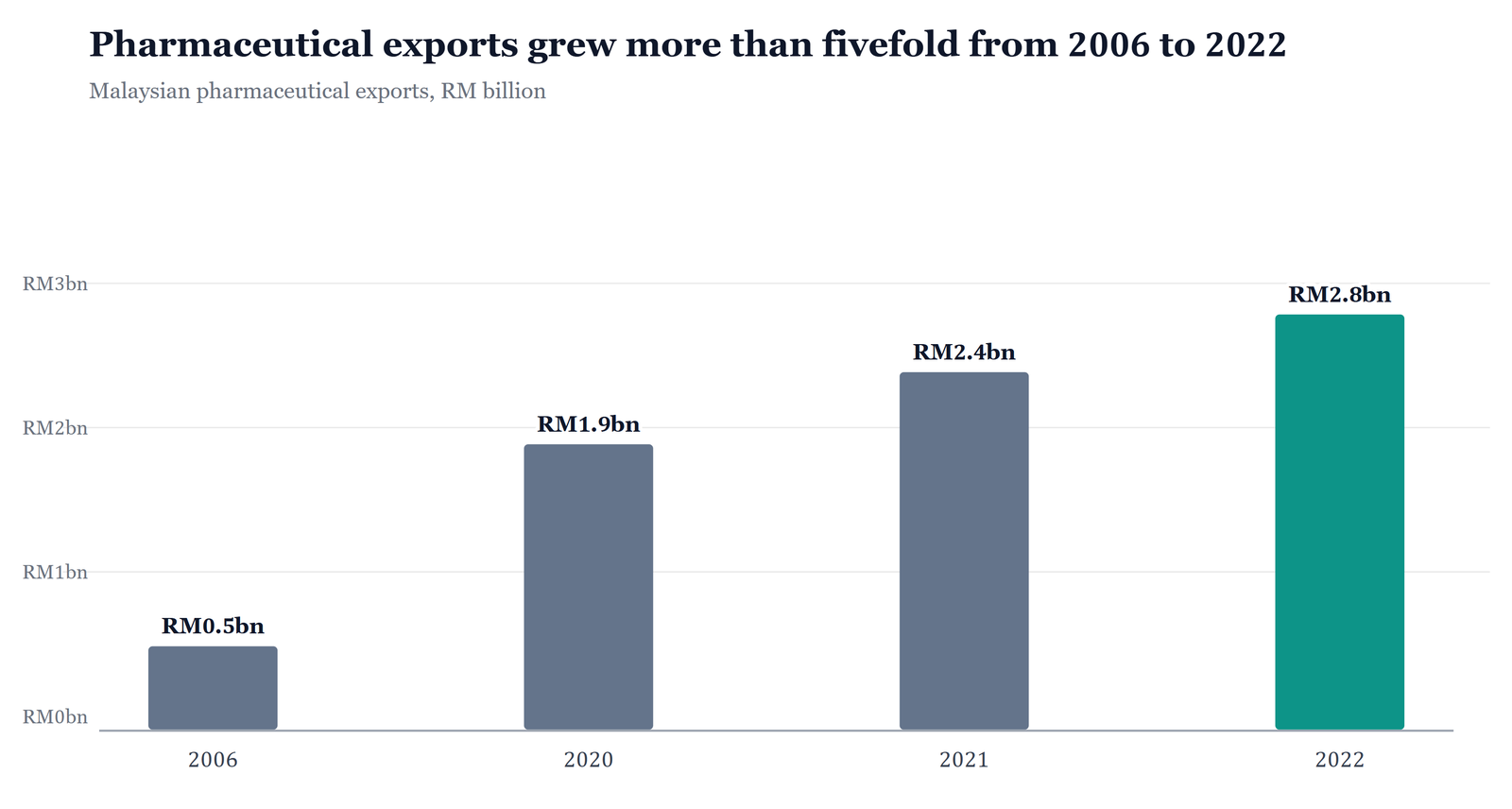
Pharmaceutical exports, a smaller base than devices, grew more than fivefold between 2006 and 2022. Employment in the industry rose from 21,320 in 2019 to 27,325 in 2022.
Budget 2027 support for both industries
Budget 2027, tabled on 9 October 2026, lets manufacturers reclaim sales tax on machinery, spare parts and equipment bought from local traders, and the facility also covers raw materials used to produce pharmaceuticals. The budget also directs RM2.1 billion from three funds to strengthen mid-tier companies in fields including medical devices: the NIMP fund; Dana Pemacu, run by the Retirement Fund (Incorporated), known as KWAP; and the MTC Fund of Khazanah Nasional, the national sovereign wealth fund.
Capability that stays at home
Datuk Seri Dr Ahmad Zahid summed up the aim the IMDEC 2026 ambitions share with the master plan: “Capital may enter Malaysia, but capability must remain in Malaysia.”
Further Reading
- Aerospace, chips, and pharma: where TVET graduates fit in three NIMP 2030 sectors
- Malaysian inventors had their busiest patent year since 2018, and the master plan backs the climb
- The lab work inside Malaysia’s net-zero mission, and the funds that can pay for it
Sources
- Ministry of Finance Malaysia. (2026). Budget 2027 speech [English translation of the speech by Prime Minister and Finance Minister Anwar Ibrahim, tabled in the Dewan Rakyat on 9 October 2026]. https://belanjawan.mof.gov.my/pdf/belanjawan2027/ucapan/bs27.pdf
- Ministry of Investment, Trade and Industry. (n.d.). Missions. New Industrial Master Plan 2030. https://www.nimp2030.gov.my/index.php/pages/view/317
- Ministry of Investment, Trade and Industry. (2023a). New Industrial Master Plan 2030 sectoral plan: Medical devices industry. https://www.nimp2030.gov.my/nimp2030/modules_resources/bookshelf/e-05-Sectoral_NIMP-Medical_Devices_Industry/e-05-Sectoral_NIMP-Medical_Devices_Industry.pdf
- Ministry of Investment, Trade and Industry. (2023b). New Industrial Master Plan 2030 sectoral plan: Pharmaceutical industry. https://www.nimp2030.gov.my/nimp2030/modules_resources/bookshelf/e-04-Sectoral_NIMP-Pharmaceutical_Industry/e-04-Sectoral_NIMP-Pharmaceutical_Industry.pdf
- The Star. (2026, August 29). M’sia targets RM50bil in medical device exports. https://www.thestar.com.my/news/nation/2026/08/29/msia-targets-rm50bil-in-medical-device-exports